
 When you are learning a language on your own, probably the most difficult part is to learn grammar by yourself.
Here’s how I tackled it,
And to help you even more, you can find your free downloadable and printable grammar planner at the bottom of this post.
Set up a grammar schedule.
Write down what tense you want to learn on what day/ week/ month.
Set goals for yourself, and do your best to achieve them. Nowadays internet and techology give us infinite possibilities, use it! Do a research on the grammar of the targeted language. Go to the library, use Google, Youtube and download a conjugation chart app to your phone, so you can look at it when you are waiting in a line, or at the doctor etc…
I’m going to show you how with French as an example:
First, I looked up how many tenses/forms there are in French
Indicatif
1. Présent
2. Passé composé
3. Imparfait
4. Plus-que-parfait
5. Passé simple
6. Passé antérieur
7. Futur simple
8. Futur antérieur
Subjonctif
9. Présent
10. Passé
11. Imparfait
12. Plus-que-parfait
Conditionnel
13. Présent
14. Passé première forme
15. Passé deuxième forme
Impératif
16. Présent
17. Passé
Participe
18. Présent
19. Passé
Infinitif
20. Présent
21. Passé
Gérondif
22. Présent
23. Passé
After, I decided the time frame I give myself to learn the tenses. I decided on 2 months, but you can absolutely alter it to your liking/speed.
As there are 23 tenses/moods mentioned above, I go with learning a new one every third day. Days marked with ‘P’ as ‘Practice’ are days when I review all the tenses.
So here is what a schedule looks like:
| 11. | 2 | 3 | ||||
| 4 3. | 5 | 6 | 74. | 8 | 9 | 105. |
| 11 | 12 | 136. | 14 | 15 | 167. | 17 |
| 18 | 198. | 20 | 21 | 22 9. | 23 | 24 |
| 2510. | 26 | 27 | 2811. | 29 | 30 | 112. |
| 2 | 3 | 413. | 5 | 6 | 714. | 8 |
| 9 | 1015. | 11 | 12 | 1319. | 14 | 15 |
| 16 20. | 17 | 18 | 1921. | 20 | 21 | 2222. |
| 23 | 24 | 2523. | 26 | 27 | 28P | 29 |
| 30 | 31P |
On days marked with a number, I go on Google and do a research about the tense.
For my first tense I found this result:
https://www.thoughtco.com/french-present-tense-1368922
Then, I write down the results like this:
- Name of the tense:
le présent de l’indicatif
- Structure:
(Basically the conjugation)
- When to use it: (with examples)
I. Current actions and situations
Je regarde la télé. I am watching TV.
II. Habitual actions
Tous les soirs, je vais au judo. I take Judo every evening.
III. Absolute and general truths
La Terre tourne autour du Soleil. The Earth revolves around the Sun.
IV. Actions which will occur immediately
J’arrive ! I’ll be right there!
V. Conditions, such as in si clauses
Si vous voulez. If you like.
After I’m done with this, I take my conjugation chart app, and for the next three days I take a look and memorize the conjugation irregular verbs and the three forms. the best thing about using apps for this, is that since it’s on my phone I can easily use it on the bus or just whenever I have a few seconds to kill. When I have more time, I like to write example sentences.
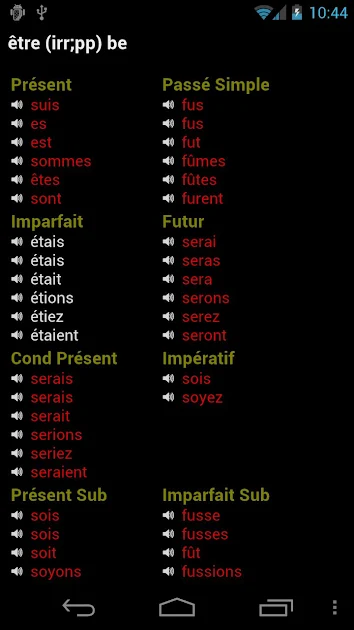
If you feel super motivated, you can just type the name of the tense and ‘exercise’ in Google and practice a little. It helps a lot. Especially if you find one that corrects your mistakes.
You can also use short videos or movies to practice a tense. Watch the video in my Watch movies effectively post on the last day of each tense segment and try to come up with a few sentences about the story of the video in the tense you are learning. I also make sure I incorporate the tense I am learning in my day to day practice.


Download your free grammar planner by clicking here.
I really hope this cleared up any confusion you might have, and inspired you to go for it,
Zsófi
Got any questions? Suggestions? Ideas? Let’s connect! I would love to hear your opinion!


- How to stay motivated when learning a language at an advanced levelRemember how exciting learning languages used to feel? The key to staying motivated is to make your learning routine engaging, challenging, and relevant to your interests. When you first start learning a language it is incredibly exciting. You want to soak up any and every single possible thing. You are ready to learn the whole … Read moreHow to stay motivated when learning a language at an advanced level
- Advanced language learning goalsIt was easy for me to set goals as a beginner. I wanted to create a simple sentence speak, then understand movies, and speak fluently. But once I spoke my target language at advanced level, like many other language learners, I didn’t know how to move forward. Until I figured out that: As an advanced … Read moreAdvanced language learning goals
- How to learn advanced vocabularyIn order to learn advanced words, you must use advanced listening and reading resources, and once you find an unknown word you have to not only translate it but also see it in context in order to be able to use it correctly. You should also put it into practice immediately by using it in … Read moreHow to learn advanced vocabulary
