

Imagine yourself chatting it up, laughing, and sharing stories and opinions with a local in your dream country in your target language.
Talking to native speakers? It is possible!
Do it gradually. If you feel shy try to overcome it step by step. You don’t have to jump in deep water, ease yourself in.
You are not alone with being shy to speak a foreign language in front of native speakers (or anyone in general). I am here to help you do it at your own pace.
Even the bravest get shy sometimes. With this safe and guaranteed method, you will talk to anybody in no time 😉
- Talk out loud
- Say a few sentences here and there
- Have full conversations in a relaxed setting

Okay. Take a deep breath. No really. And let’s see how we can do it eventhough we are scared, all right?

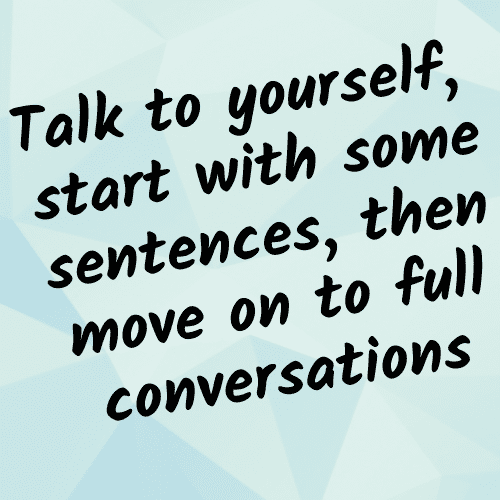
As a first step, try to talk to yourself out loud for a stress-free start. Record yourself talking about your day. This will help you to get comfortable with expressing your thoughts in another language.
The next step is to ask native speakers about some problems or questions you may have. So instead of asking them for examples, try to come up with examples and ask them if your examples are correct. Don’t just ask them, ‘how do I order at a restaurant?’. Try to give an example of how you would order, and ask them if it was understandable and correct. This is a great way to “try out the water before you dive in” to gain more confidence. Instead of having a full on conversation in your target language, which can be very intimidating, you can start by saying some sentences here and there. This also helps you to understand, that most native speakers are happy to help you when they find out that you are wanting to practice their language.
Then finally, you can have full conversations. I recommend starting at a place where you feel at ease. Go to a local hostel’s bar, or to an international party and have fun. You will care less about your grammar and more about having a good conversation! The reason why we speak languages is to give and get information. Yes, you should improve your grammar and your pronunciation, but you should not be so worried about using the perfect grammar structure when all you want to do is have a good conversation. We get so afraid when we have to talk to a native speaker because we think it’s a language exam and if we make mistakes we get a bad grade. You should strive to perfect your pronunciation and your grammar, but that should not be your primary concern when talking with someone.
Still scared? Not ready yet?
As a step after talking to yourself, write comments on Instagram or Youtube. It gives you the feeling and adrenaline of talking to a native but also gives space for structuring your thoughts, to double check, and in some cases anonymity. Find celebrities, athletes and singers you like and comments on their picture, even if it is just a few words. Got a question about a DIY project on Youtube? Ask away!
Once you see that people actually understand you, and you realize that you can exchange information in your target language once you get over your initial nervousness, you can move to the next step.
Bonus tip: When you are talking to someone, and suddenly can’t remember a word, instead of freezing down, and trying to remember that word, try to explain it differently. It is ok to feel frustrated about it, look it up later if it really bothers you, but don’t let it get in the way of a conversation.
I hope this gives you courage,
Zsófi
Got any questions? Suggestions? Ideas? Let’s connect! I would love to hear your opinion!


- Advanced language learning goalsIt is easy to set goals as a beginner. You want to speak fluently, want to understand movies, or maybe just simply create a sentence. But what can you look forward to once you’ve achieved all of this? As an advanced language learner, you can make it a goal to repeat words less and use … Read moreAdvanced language learning goals
- Language learning motivation for advanced learnersSay no to monotony and lack of new impulses and challenges, and get back on track. Buckle up ’cause in no time your passion for languages will be back. I guarantee you will feel the rush of emotions you used to feel in the beginning again.
- How to learn advanced vocabularyIn order to learn advanced words, you must use advanced listening and reading resources, and once you find an unknown word you have to not only translate it but also see it in context in order to be able to use it correctly. You should also put it into practice immediately by using it in … Read moreHow to learn advanced vocabulary
